
The music of a new humanity

Imagine doing all your mathematical calculations on a trumpet. Imagine a symphony or a brass fanfare written to solve a complex number puzzle. Imagine a computer that worked on an overtone series, such that the same circuit would have different functions and solve different problems when pitched at a different note in the overtone series. Imagine a logical gate that would behave differently at a different overtone. Imagine reducing a Miles Davis solo to a mathematical algorithm, or better yet, imagine that Miles Davis was inscribing in vinyl and into the cosmic memory a dissertation on mathematics.
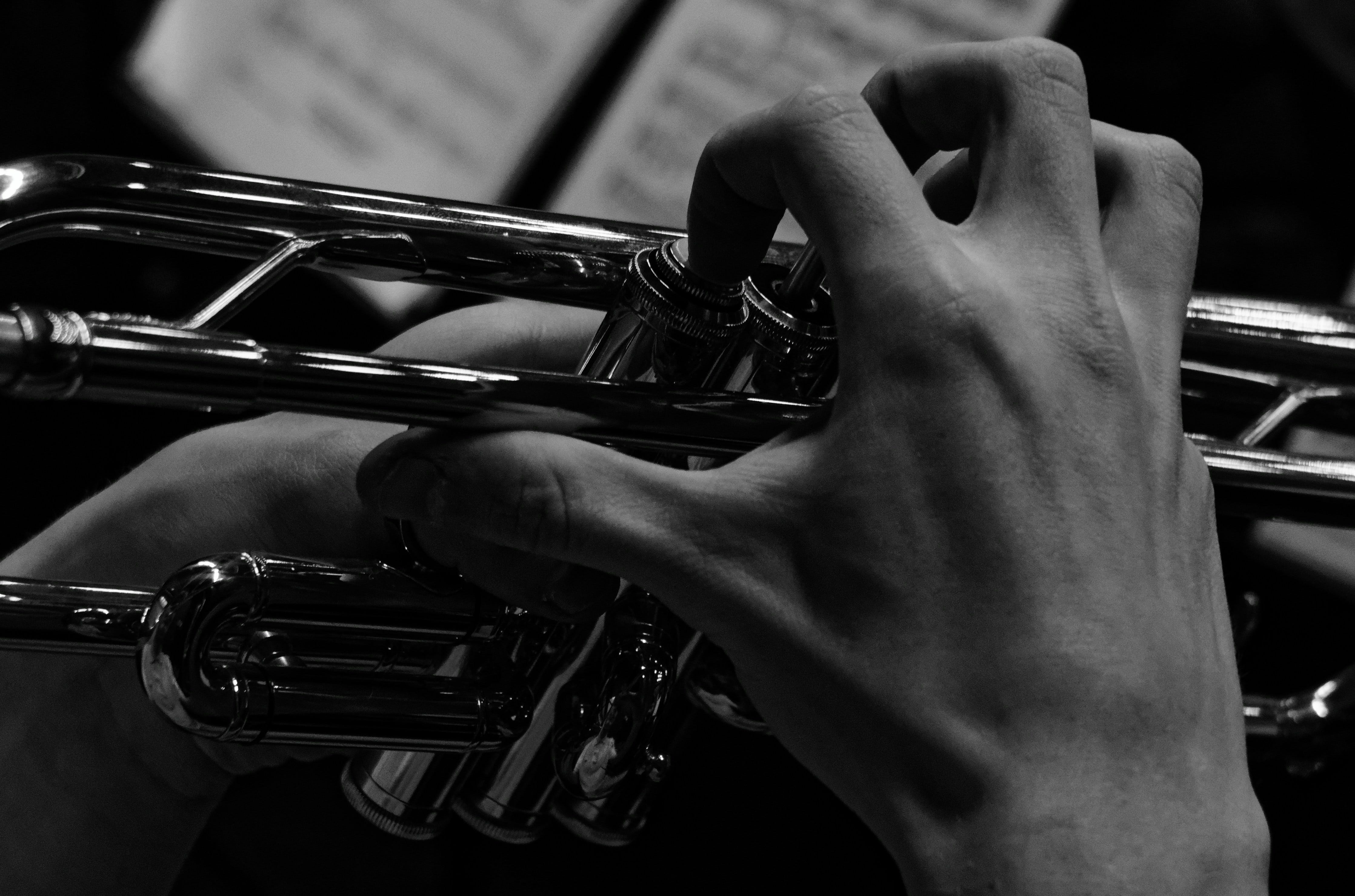
Why don’t computers use a three-bit byte? Imagine the headlines: “Symphony for a three-bit byte on an overtone series saves the day”; “Dizzy heights solve problem with bridge cables: Gillespie’s ‘Night in Tunisia’ results in new cable design”; “Verve signs long-term contract with British Aerospace to provide artists in residence for the aeronautical design section”.
Imagine a mathematics in base 7, based on a three-bit byte with one bit redundancy built in. Imagine a mathematics in base 7⁹, built around the first 9 notes in an overtone series which has to cope with the various redundancies of the higher overtones.
Imagine a mathematics in a planar base, not a linear base, but a planar base translated into musical pitches.
Imagine.
Throw rhythm into the equation.
Toss in harmonies and counterpoint. Counterpose that thought.
Pulse and mind.
Timbre.
Spacing.
Imagine the scientific papers: “Utilising the concept of blue note to solve multi-linear regressions”; “Applying bebop scales to fluid-flow problems.”
Imagine a computer that could calculate the difference between an Ornette solo and Ornette’s theory of atonality.
Imagine a hand-held device that could second-guess Anthony Braxton and Roland Kirk and then translate their melodic devices into drum solos or solutions to integrals of complex polynomials that could save a life or reduce carbon emissions if applied to vascular fluid dynamics or heat transfer in exhaust gases.
Imagine a day when a posthumous Woody Shaw solo could save a life or reduce our reliance on fossil fuels.
Imagine a day when a laser diffracted off an lp groove could form the basis for new algorithms to cut data loss in communications.
Consider the humble trumpet.
One of the first computing devices.
One of the first digital-analog interfaces.
Imagine fibre optics before bebop. Not possible. Inconceivable.
Imagine a world in which no-one had stepped on Dizzy’s trumpet and made it possible for our collective imagination to conceive of a way of rectifying signals from bent notes.
The trumpet is the original and ultimate signal gateway, where the digital, the analog and the quantum leap together.
Imagine if Ornette didn’t play trumpet. Some trumpet players might say that would take no imagination. But can you imagine a world where you could look at a note and hear it at the same time?
What instrument did Heisenberg play?
If Ornette hadn’t played the trumpet, the digital-analog-quantum leap may never have occurred. We cannot hold both thoughts in our mind at once. We cannot hold both thought and mind at once. We cannot hold both thought and mind at one.
Imagine Lester Young on trumpet. He didn’t need the digital horn. He had the digital hands. Analog device, a saxophone. Analogous advice, the saxophone.
But Bird put the digital back in with upper chord tones. Analogous to overtones (analogous device, advised the saxophone). The digits on the page. Analog horn. Digital advice. Digital dexterity. Spiritually precise.
(4 August 2010)
Also published on Medium.com
You can find me on:
LinkedIn: https://www.linkedin.com/in/tim-pilbrow
Medium: https://medium.com/@tim.pilbrow
What an interesting concept. I don’t know much about music but the idea of seeing and hearing it simultaneously is fascinating. Can AI make this a reality?
I was just being a little frivolous and fanciful!
I played the trumpet very briefly as a child, and was struck by its binary system. Three valves with two positions each gives you 8 possibilities, then you have a series of overtones, with 8 possibilities on each overtone, and you build up a scale that way, with some reduplication. You could do simple calculations with a trumpet's three valves. (I then moved on to other instruments (saxophone, mainly), and consider myself an amateur musician).
That got my mind spinning. How might a melody--which is always a problem solution, like how to get from the starting note to an ending note that resolves pleasantly, but in-between it takes you along an interesting path of diversions and false endings and comic relief and so on.
I'd rather not have AI do this for me, because creating music is immensely satisfying as a human endeavour. But I do wonder whether our cold, mathematical approach to everything could be lightened up a bit. And maybe, just maybe, there's something to my idea that algorithms based on musical solutions might change the way we program the tech that supports our lives.
I meant it as a bit of comic relief. But I kind of wish it could be true. In the way that a different mathematical tradition might find a quicker solution to a problem than the way I was taught at school (I am in no way a mathematician, though!). I see those Instagram posts showing students from different traditions doing multiplication and division using different systems, where one is way faster than the other, and I am fascinated.
There is a mathematics of music (or poetry). There's also a music (or poetry) of mathematics. I like to play with the different ways of thinking those possibilities suggest.